
Blog Post: Public majorities worldwide support a democratic global government focused on transnational challenges like climate change, Oxford/Dublin research shows
Public majorities worldwide support a democratic global government focused on transnational challenges like climate change, Oxford/Dublin research shows
Dr. Farsan Ghassim, University of Oxford
Dr. Markus Pauli, Dublin City University
Citizens around the world support very far-reaching reforms of global governance, finds our study in International Studies Quarterly. Overwhelming majorities in various countries across the global South, North, East, and West support the creation of a democratic world government to tackle pressing global challenges like climate change.
Long supported by the likes of Einstein, scholars and advocates today promote similar ideas such as “cosmopolitan democracy.” However, such proposals are often discarded quickly, based on the argument that most people would not support them. Our study refutes such claims.
We implemented an international survey experiment to explore public support for different notions of a world government. Between 2017 and 2021, we surveyed more than 42,000 respondents in 17 countries worldwide, representing 54 percent of the world population. Respondents in each country were randomly assigned to either the control or a treatment group. People in the control condition were asked to what extent they support or oppose “the establishment of a world government”. For another group, the proposed world government was specified as democratic; while yet another treatment conceptualized global government as focused on transnational issues, later including COVID-19 during the pandemic. Lastly, the full proposal we focus on here combined the democratic and global issues specifications:
The establishment of a world government which should be democratic in that people worldwide would be represented through free and fair elections or other ways of citizen participation, and which should have the right and the power to deal with global issues like climate change, world poverty, and international peace; while national governments would maintain control over issues that are not global.
Figure 1: Response proportions by condition across countries, using equal weights
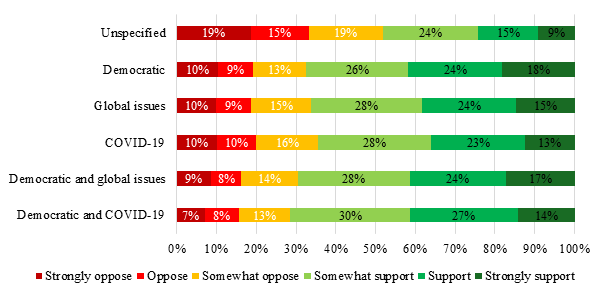
Notes: Potential deviations from 100 percent in each row are due to rounding. See Table 1 in our online appendix for details on the survey setups.
Figure 1 shows that support across countries (weighting each country equally) rose from 48 percent when unspecified to 68 percent when it was made clear that the proposed world government would be democratic and 67 percent when focused on global issues. Moreover, 69 percent of respondents across countries supported a democratic world government focused on transnational issues. During the pandemic, when we specified the focus of a democratic world government as dealing with COVID-19, support rose to 72 percent across countries.
When weighting countries based on their population sizes (rather than equally), 72 percent across our survey countries supported a democratic world government focused on transnational issues (see Figure 2). With population weights, even the unspecified world government proposal was supported by 58 percent across our survey countries.
Figure 2: Response proportions by condition, across all countries, using population weights
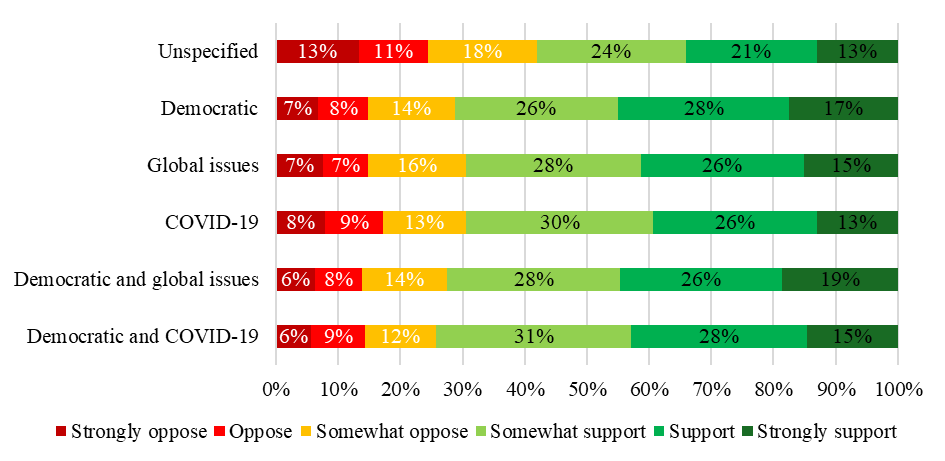
Notes: See notes below Figure 1.
Figure 3 shows that majorities in all our survey countries – except for the United States – supported the proposal of a fully specified world government. Egypt, India, Kenya, Indonesia, South Korea, and Colombia had the largest majorities in favour, ranging from 82 percent to 77 percent of respondents supporting the idea. In Europe the support ranged from 75 percent in Hungary via Turkey (73%), Spain (70%), and France (67%) to 64 percent in the United Kingdom.
The US was the only surveyed country without majority support, as only 45 percent supported the idea. It also had by far largest share of “strongly oppose” answers with 24 percent. Argentina and Russia were the next least supportive nations, but still 56 percent and 58 percent respectively of respondents there endorsed such a world government.
Figure 3: Attitudes on democratic world government focused on global issues, by country
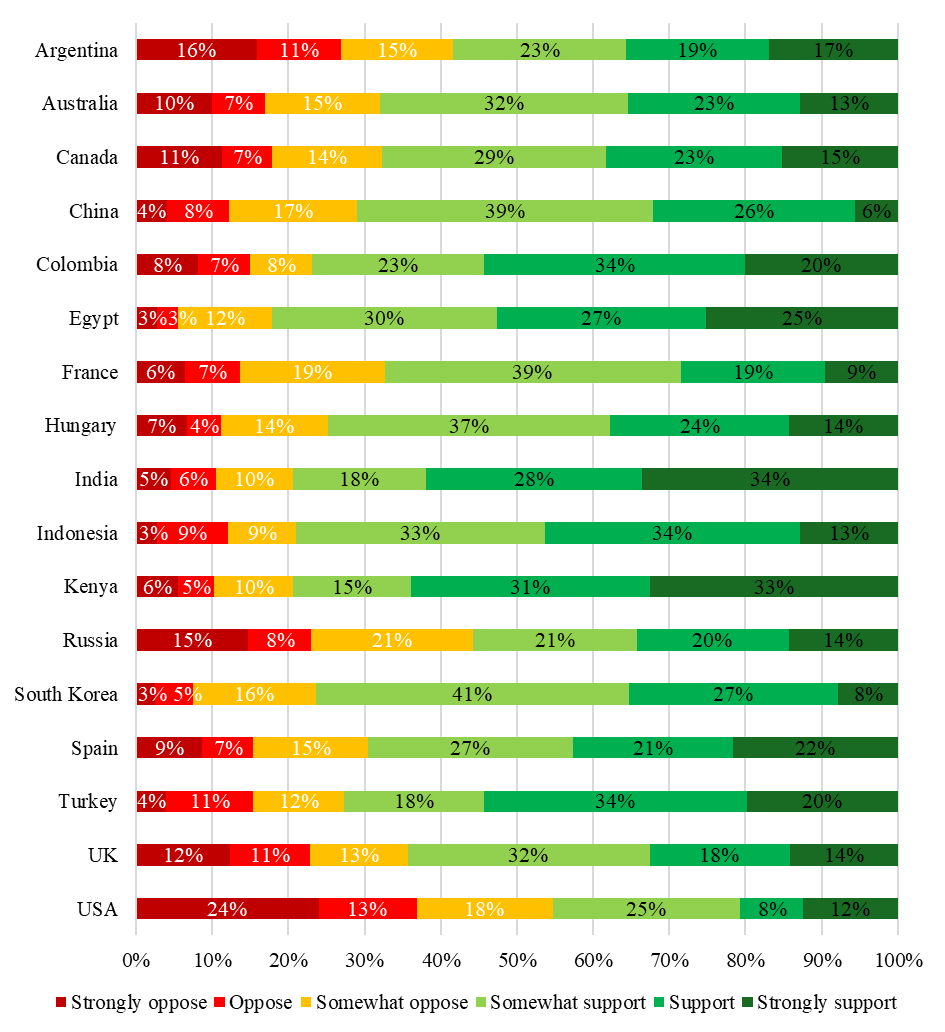
Notes: See notes below Figure 1.
Generally, support for a democratic world government focused on transnational issues is even stronger in less free, less powerful, and/or less developed countries (see Figure 4). Our article discusses the hope for more international influence (in less powerful countries) and a more democratic say on global issues (in less free countries) as some of the possible reasons.
On the flipside, fears of global wealth redistribution in such an alternative world order may partly explain why support in richer countries (66 percent on average) is six percentage points lower than in poorer countries. Similarly, even though clear majorities in free countries support a democratic world government focused on global challenges (56 percent on average), support there is substantively lower than in partly/not free countries (75 percent on average), indicating that fears of losing democratic privileges may be a factor in the former group.
Figure 4: Full specification results, across countries, equal weights, by country groups
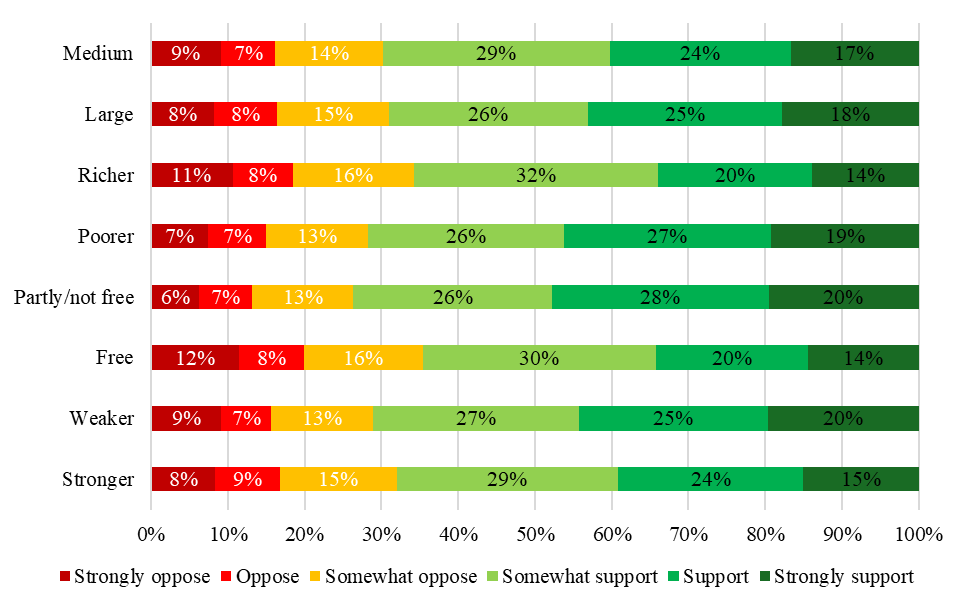
Note: See our article for further explanations on this figure.
In sum, our study reveals a largely overlooked side of present-day world public opinion: majoritarian support for much stronger and more democratic global governance. These findings are especially relevant at a time when the world faces major transnational challenges such as climate change, wars, and mass migration. Our results encourage current reform efforts by international organisations such as the United Nations, including the UN Summit of the Future,and NGOs like Democracy Without Borders and Iswe Foundation advocating for global governance transformations.
Find the article here: https://doi.org/10.1093/isq/sqae105
Authors’ short biographies
Dr. Farsan Ghassim is a Research Fellow in Politics at The Queen's College, University of Oxford. His research concentrates on global governance and survey methodology. He previously worked at Bain, the German foreign service, the EU Parliament, and the United Nations. He holds a DPhil in International Relations (Oxford), an MA in Global Affairs (Yale), and a BSc in Management (LSE).
Dr. Markus Pauli is Assistant Professor in Political Science at Dublin City University. He has held positions at Yale-NUS, the National University of Singapore (NUS), Singapore Management University and Heidelberg University; and studied at the Freie Universität Berlin and the London School of Economics and Political Science (LSE). He co-authored Statecraft & Foreign Policy: India 1947–2023; and Collaborative Governance for the Sustainable Development Goals.
Photo by Mathias Reding on Unsplash


